Customer engagement has become pharma’s most controllable growth engine
Same brand, different decisions: Context changes everything
Each year, 3.3 million fans walk into Yankee Stadium in the Bronx, among the highest attendance figures in global sports.
To optimize the experience for every one of them, the organization doesn’t start with preprogrammed campaigns, offers and static audience buckets. It starts with a simple question: “What decision is this specific fan trying to make right now, and how can we help?”
If rain is in the forecast, the obstacle isn’t lack of passion—it’s unpredictability. Offers shift toward covered seats and guarantees. If a parent is in the stadium with children, the app surfaces bundled food credits and access to faster exit lanes.
Same “iconic” brand, just different fans, different context and completely different customer engagement and offers. Fans just need help making their decision feasible in the moment.
This is exactly where pharma is today. When clinicians already trust the science, customer engagement built on real-time relevance isn’t enough. The real question becomes, “What can we do right now to either remove a barrier or amplify a motivator to enable a decision?” In fact, a ZS study found that clinicians value context-specific information from pharmaceutical companies twice as much as product-focused messages.
Why customer engagement has become the ultimate battleground and growth engine
The operating environment for pharma has become more complex and less forgiving, creating a narrower window of opportunity and raising the bar for commercial execution.
Multiple concurrent forces are pushing leaders to rethink customer engagement:
- Portfolio reconfiguration pressure is intensifying. By 2030, roughly $190 billion in global revenue—or about 35% of 2024 sales for the top 10 pharma companies—will be exposed to loss of exclusivity (LOE), per ZS analysis. While the scale mirrors the 2010-2015 patent cliff, the dynamics this time are tougher. That’s because a higher share of biologics will face faster, more intense biosimilar competition and because U.S. pricing is unlikely to provide the same offset it once did.
- Launch intensity is rising, while the payoff is growing less predictable. The industry is on pace for roughly 70 launches per year through 2030, also per ZS analysis. While many launches meet or exceed initial expectations, sustaining momentum has become harder as competition intensifies and blockbuster concentration declines—making growth less durable and amplifying the cost of every misstep.
- Pricing as a traditional backstop is weakening. Policies—particularly Most Favored Nation (MFN) in the U.S.—are pushing pharma to rethink pricing models. U.S. pricing pressure is triggering a global reevaluation of pharmaceutical pricing structures, directly impacting affordability and market competitiveness. This not only creates top-line pressure but also drives a squeeze on operating margins as discounts and rebates flow through.
- AI is now a CEO mandate. CEOs now see themselves as the primary decision maker on AI, with many believing their jobs depend on getting it right. Our analysis suggests that, depending on portfolio mix, large pharma companies could unlock $2 billion or more in enterprisewide AI value. And as we know, customers expect it, which means there is no more wiggle room but to get it right.
As these forces converge, one reality becomes hard to avoid: Many traditional levers on which pharma has relied—pricing, market access, even pipeline—are becoming less predictable or less controllable. While companies can influence key growth levers, customer engagement is the one factor they can continuously optimize every day. Companies can control a range of variables, including customer segmentation, promotional mix, content inventory, customer barrier removal and omnichannel orchestration, to great effect to engineer commercial outcomes.
How has customer engagement affected commercial results?
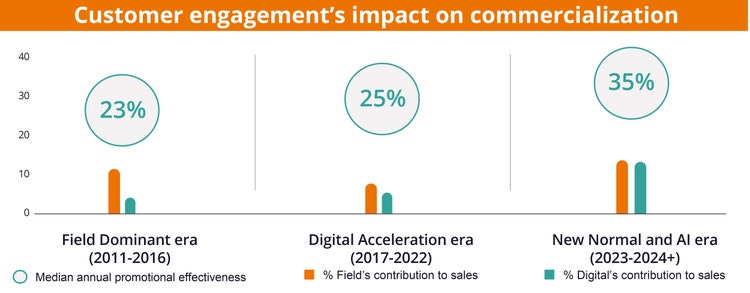
Importantly, customer engagement has delivered real impact over the past 15 years. Across three industry waves—from field dominant models to digital acceleration and today’s AI enabled “new normal”—customer engagement’s contribution to commercial sales has risen from the low 20% range (2011-2016) to 35% (2023-2024), per a ZS analysis of marketing mix for U.S. pharma brands with more than a billion in annual revenue.
Customer engagement’s growing role in commercialization reflects a decade of advances in personalization, including more dynamic targeting, cohesive field and marketing orchestration, and greater digital reach and scale. Over the same period, digital spend as a percentage of marketing investment has grown multifold across therapeutic areas, and digital’s contribution to sales is approaching that of the field’s.
FIGURE 1: Customer engagement’s contribution to commercial sales has risen over the past 15 years
While customer engagement has delivered meaningful value and contributed to a growing share of commercial performance, many of the practices that fueled the last decade of growth are becoming table stakes. To create separation, pharma companies will need to outperform previous benchmarks by dramatically shrinking their distance to customers and patients. The next era of customer engagement will not be defined by doing more of the same. It will be defined by four winning conditions.
1. High-impact customer engagement demands raising the bar on personalization
Much of what we call personalization today is designed around orchestration based on customer preferences. While it’s delivered meaningful top-line impact by optimizing customer engagement—whom to target; and what message to deliver, when and through which channel—this approach is delivering diminishing returns under today’s market realities.
This is because commercial outcomes are not based on relevance alone. They also depend on the company’s ability to address real-world constraints that hinder customer action. When frictions exist in the system, even if we improve relevance, conversions can still lag.
FIGURE 2: Current personalization approaches are reaching their limits
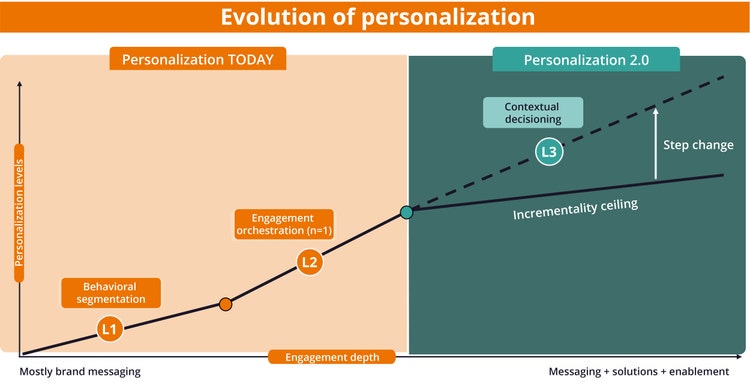
What barriers are preventing a decision? And what drivers can be used to accelerate a decision? Context offers commercial teams an additional lever to combat unfavorable clinical beliefs, operational constraints and financial considerations.
If a customer is “formulary access-blocked,” the best engagement experience is not more clinical messaging. Instead, it makes more sense to anchor engagement around coverage pathways and prior authorization solutions. Personalization shifts from “telling customers why to buy” to “helping them how to buy.”
2. Why launch is customer engagement’s ultimate stress test
Launch momentum is accelerating at a time when reaching the peak quickly—and sustaining it—has become more difficult than ever. Analysis of hundreds of launches across multiple therapeutic areas points to a consistent reality: Underperformance reflects a systemic breakdown between ambition and real world adoption that compounds as launch density increases.
Three dynamics explain why launch performance breaks down:
- The ambition-reality gap is structural, not episodic. ZS’s analysis of the past decade of launches shows that 36% of launches miss Year 1 consensus forecasts, and only about 10% of assets reach peak revenue in four years or fewer. The remaining 90% take six to eight years (or more) to reach peak, reflecting a systemic—not situational—pattern.
- The middle is where the trajectory dies. While 25% of assets peak around Year 6 and 65% peak at Year 8 or later, the two to four year gap between early ambition and real world uptake is where billions in forecasted revenue quietly disappear through slow underperformance rather than visible failure.
- Winning pre matters significantly. Prelaunches that outperform are distinguished less by superior science than by commitment to early investment in customer engagement infrastructure—often beginning as early as eighteen months out. This customer engagement infrastructure may include the setup of customer intelligence tailored for launch, including living-account narratives collected from medical and commercial teams; evidence-driven scientific content inventory and disease education campaigns; and cross-functional launch war rooms with underlying decision analytics. Underperformers, by contrast, attempt to build customer engagement capabilities only after momentum has already stalled.
This is why launch is the most unforgiving test of customer engagement. When engagement is designed primarily to persuade, performance breaks down precisely when decisions become operationally complex. When it’s designed to enable action, on the other hand, it builds early momentum and makes course correction far less costly.
Launch is not simply a go‑to‑market event—it’s a customer engagement challenge that exposes whether an organization has moved beyond persuasion and into decision enablement.
3. Evolving portfolios are driving an identity shift for pharma—new commercialization muscles are needed
For two decades, large pharma built excellence around specialty depth, blockbuster concentration and HCP- and institution-centric commercial models. That’s starting to change now.
Today, companies are reshaping portfolios toward cardiometabolic disease, immunology, obesity and neurology, forcing many organizations to rethink their identity fundamentally. Growth is becoming more distributed and increasingly consumer visible, with brands operating closer to retail settings.
This shift exposes a core tension: Specialty excellence doesn’t automatically translate to consumer adjacent categories. Organizations built for deep specialist access and system driven go to market models often find those same strengths strain as portfolios broaden.
Competing in this environment requires new business models and new commercialization muscles—including fluency in engaging consumers as well as primary care providers and mastery of new channels such as direct to patient (DTP).
Direct to patient is about more than digital convenience
DTP platforms sit at the intersection of retail grade consumer expectations, care journeys and policy tailwinds. What looks like digital convenience on the surface is really a structural shift in how care is accessed, prescribed and fulfilled.
To compete in a consumer-first go-to-market model, pharma must be comfortable operating with digital-native discipline—which includes mastery of digital commerce. This means offering premium onboarding experiences, establishing subscription-based engagement models with automated refills and home delivery, and enabling AI-driven personalization that can predict drop-off risks and tailor education and support.
Shifting portfolio configurations toward population therapeutics has already pushed many pharma companies to offer DTP channels. The real question for pharma isn’t if the industry can build and offer this channel. It’s how individual manufacturers scale their platforms and differentiate from competing offerings.
Winning the first click in patient journeys and pharma’s hidden advantage
A ZS study of more than 350 healthcare consumers using either pharma sponsored DTP platforms or digital native providers such as Ro, Hims and Hers revealed that digital-native players are more effective at driving early awareness through coordinated, surround-sound media strategies that help capture the first click. Pharma DTPs, on the other hand, depend largely on healthcare providers (HCPs) to drive patient awareness.
But pharma possesses a distinct strategic advantage in the U.S. compared with companies working in less-regulated industries, namely: access to granular prescription and claims data.
With the rise of DTP, clean-room environments and identity-stitching technologies, pharma companies can create a granular, customer-grade intelligence layer by responsibly and compliantly combining prescription signals with lifestyle, health and fitness data and even media habits offered by third parties. In this way, DTP may offer the perfect vehicle to strengthen the industry’s first-party data capture capabilities dramatically.
4. When intelligence becomes ubiquitous, advantage shifts to execution velocity and autonomy
In the digital acceleration era, AI made engagement smarter by analyzing data and recommending actions. Humans still had to connect the dots and execute. We’re now entering an era where AI can do both.
With agentic, AI can understand context, reason on its own, take action autonomously and learn continuously. This creates an interesting leadership dynamic as it challenges leaders to not just automate business processes but reimagine them, make swift decisions on decision rights, assess build-versus-buy trade-offs and commit to a pragmatic path to scale.
Take marketing mix: Today, it’s a highly linear, 10–12-week process heavily reliant on data collection, model reruns and multiple coordination points across teams. Agentic changes that by reshaping the process: It continuously ingests data, keeps models pretrained and always on, generates scenarios in real time and uses agents to compare results against benchmarks and critique outputs collaboratively.
The approach can condense end-to-end marketing mix projects by up to 50%, per ZS analysis, and provide marketers with superior human-in-the-loop decision-making abilities. This is because marketers spend less time waiting on analytics and more time making capital allocation decisions, course-correcting midyear and having conversations with the systems in natural language.
This isn’t just a tooling shift. It’s a process and governance shift.
What governance means in the agentic era
In the agentic era, governance shifts from approving outputs to defining the decision boundaries within which systems are allowed to act. That includes:
- Who sets the boundary conditions
- Who gets override authority
- Who audits the system’s reasoning
With agentic, organizations are no longer just approving content or decisions. They’re approving the systems that decide and act.
Historically, teams governed outcomes after the fact. Going forward, leaders must decide where autonomy is allowed, when escalation is required and how accountability is maintained as systems act at speed. At scale, agentic AI enables customer engagement to move from intelligence to action—reliably, responsibly and fast enough to matter.
Winning requires a new standard for customer engagement
Pharma has historically competed on a familiar set of advantages—science, scale, access and established commercial models. Customer engagement has been part of that equation, but today’s environment demands a fundamentally higher standard.
The winners will be the companies that sharply reduce their distance from customers—understanding not just who they are, but the context in which decisions are made. They will build organizations that master multiple commercial models simultaneously—deliberately matching engagement to the realities of different therapeutic areas, product life cycle stages and customer groups. Just as important, they will build the speed and governance to adapt as conditions change.
In the next decade of pharma competition, customer engagement will no longer be just another lever for growth. It will define it.
The authors would like to thank Mehul Singh, Pranav Mankikar, Komal Gurnani, Shantanu Ballal, Karishma Trikha and Victoria Summers for their contributions to this article.
Related insights
zs:topic/ai-and-analytics,zs:topic/marketing,zs:topic/sales,zs:topic/strategy-and-transformation,zs:topic/data-digital-and-technology