How pharma can turn CRM and digital transformation into measurable business value
Connecting CRM, agentic AI and tech transformation to business impact
As life sciences organizations modernize customer relationship management (CRM), adopt agentic AI and expand digital capabilities, many still struggle to convert technology investment into measurable business value. Adoption metrics, system utilization and successful deployments don’t automatically translate into better business outcomes or financial performance. Instead, value realization depends on aligning strategy, operations, technology and accountability around a shared business vision.
A business integrator helps bridge the gap between technology implementation and business impact by connecting enterprise objectives, future capabilities and value measurement. Organizations that establish this role early can better align stakeholders, incorporate emerging innovations and create the financial rigor needed to turn CRM investments into measurable business results.
Life sciences CRM is moving from memory to mind, but value won’t happen by default
There’s a moment of serendipity in the life sciences industry right now. From choosing new CRM platforms to implementing agentic AI to breaking down customer barriers, we’re seeing an evolution of what CRM can be. It’s evolving from a “system of record” to become an ecosystem of context, intelligence and activation, moving from CRM as a “memory” to CRM as a “mind.”
But many organizations aren’t set up to capture the full business value of a next-generation CRM transformation. Success starts by treating CRM not simply as a technology initiative, but as an opportunity to solve persistent business pain points, fundamentally improve how work gets done and realize measurable outcomes.
3 ways technology value in life sciences breaks down
Platforms can go live; user adoption can rise; dashboards can turn green. And still leadership will be asking, “What has actually changed in the business?”
We’ve observed three risks that organizations face in realizing the full business value of CRM investments:
- The transformation stops short of its full ambition, with a lack of true alignment across parallel siloed initiatives
- The program builds for the requirements of today rather than the possibilities of tomorrow enabled by agentic technology
- Efficiency and effectiveness gains from the transformation never make it to the P&L, with no clear accountability or mechanisms to translate operational improvements into measurable outcomes
What is business integration in CRM, agentic AI and tech transformation?
To overcome these challenges, organizations need a dedicated business integrator function that connects the enterprise vision, aligns execution across initiatives and keeps value realization at the center of CRM, agentic AI and broader technology transformation.
FIGURE 1: A business integrator function
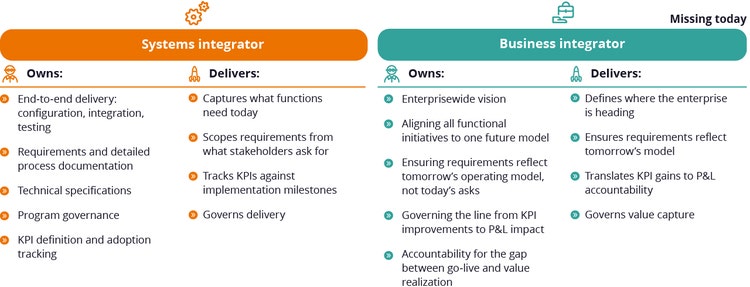
It’s important to understand the difference between business integration and systems integration. A systems integrator owns the end-to-end delivery and delivers on the business needs of today, for the scope defined. They’re not structured to own business model change or the gap between go-live and value realization.
The companies getting CRM transformation right are the ones that designate a business integrator before the build begins, when overarching strategy can still shape requirements and value capture can be built in from day one. The business integrator helps the organization own its corporate objectives for its transformation and steers all of the existing functions to the same destination. It makes sure that innovations get integrated into the CRM program and is accountable for gaps between go-live and value realization.
In many CRM programs, this business integration role is still underdefined, yet it may be the missing capability that determines whether a transformation becomes a technology rollout or generates sustained business outcomes.
How does business integration improve CRM value realization?
Here’s how the business integration function addresses the three risks:
Risk No. 1: The transformation stops short of its full ambition
When lacking explicit focus on the business model and required changes in ways of working, aggressive timelines and functional silos compel organizations to focus on getting the technology right and leaving the harder shifts unrealized. A business integrator helps the organization own the collective North Star for the business goals of the tech transformation. The integrator can help by:
- Defining the enterprise ambition for customer engagement or field orchestration, so the build is guided by a clear strategic North Star rather than disconnected functional requirements.
- Using cross-functional workshops to surface parallel innovation initiatives, identify overlaps and gaps and decide which capabilities need to be incorporated into the transformation roadmap.
Risk No. 2: The program builds for the requirements of today rather than the possibilities of tomorrow
Translating platform capabilities into realized value requires deep knowledge of the business model innovations and future agentic workflows on the horizon. Lacking that explicit knowledge, it’s easy to fall into the trap of designing for what’s asked for today (or even slight improvements over today), instead of capturing the possibilities of tomorrow.
Here the business integrator plays a forward-looking role:
- Anchor requirements on future value streams and agentic capabilities, not just today’s workflows.
- Reexamine workflows through the decisions and outcomes they’re meant to drive, not merely improve the workflows themselves.
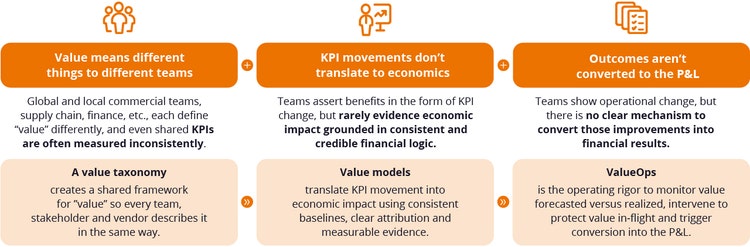
Risk No. 3: Efficiency and effectiveness gains from the transformation never make it to the P&L
This happens when teams show operational change, but there is no clear mechanism to convert those improvements into financial results. The business integrator establishes the alignment and discipline to generate sustained business outcomes through three practical tools:
- A value taxonomy that aligns teams on the value domains, levers and KPIs that matter
- Value models that translate KPI movement into credible economic impact
- Value operations (ValueOps), the operational rigor that continuously compares forecasted value with what actually lands, triggering action when value starts to drift
FIGURE 2: Closing the value gap
Without that rigor, KPI progress can create a false sense of confidence. A CRM program may show strong next-best-action adoption, but if reps are acting on recommendations mainly for lower-value HCPs, or if those actions aren’t converting as expected, the economic impact will fall short. Without value models to tell us value is off track, and ValueOps to diagnose the reason, this goes undetected for months. Program dashboards are all green; leadership assumes value is landing and doesn’t discover the gap until year-end, when it’s too late to act.
The goal isn’t to account for every dollar with perfect precision; it’s to create enough financial rigor to trace investments to operational improvements and intervene early when value starts to drift.
5 questions to ask yourself as you conduct your digital transformations
To assess whether the necessary capabilities are in place to realize the full business value of CRM, agentic AI or broader technology transformation, there are tough questions any leadership team should ask themselves:
- Is there one enterprisewide vision for how customer engagement or field experience will work differently, and has every function signed off on it?
- Do your business requirements reflect where the business is going or where it’s been?
- Do all teams—business, capabilities, technology and vendors—define and measurevalue using the same language?
- Can you trace any KPI improvement to an actual P&L line, and name the person accountable for making that conversion happen?
- Who owns value drift, and are they empowered to intervene before it shows up as a go-live surprise?
The organizations that capture the greatest value will be those that integrate ambition, execution and accountability from the start and keep value realization at the center long after go-live.
Related insights
zs:topic/strategy-&-advisory,zs:topic/data-digital-and-technology