Digital strategies to increase supply chain resiliency
Supply chain leaders know they can’t mitigate risk without enhancing operations through data, analytics and technology, but they also know digital transformation is easier said than done. Many are wary of repeating the mistakes of others, such as GE’s 2015 launch of GE Digital to centralize its initiatives. Lacking a comprehensive strategy, a strong change management plan and a focus beyond short-term results, GE Digital struggled to achieve its goals.
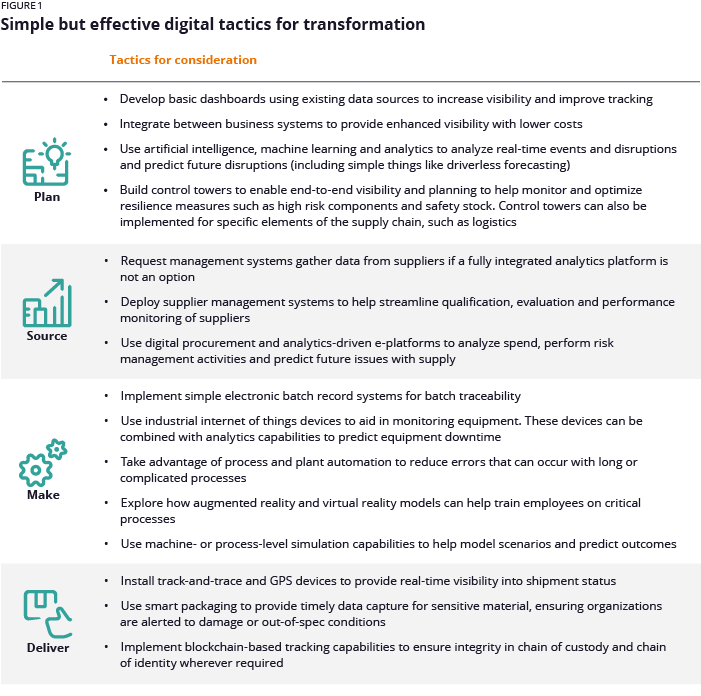
Thankfully, there are straightforward tactics supply chain leaders can take to avoid similar failures. While gold standards in supply chain digitization keep evolving, even small improvements can make a significant difference for manufacturers. One strategy to move forward is to use a plan-source-make-deliver framework (see Figure 1) to determine which actions you could take to build a more resilient supply chain. Following this strategy can also make it easier to both identify quick wins and long-term roadmap activities.
Companies that succeed in digital transformation
What do companies with successful digital supply chain transformations have in common? We’ve noticed many of them share some or all of these characteristics. These companies:
- Align leadership on the purpose and goals of transformation. Is the goal to drive down production costs? Realize supply chain and manufacturing efficiencies? Support a corporate sustainability initiative? Or make operations more resilient? It’s critical for leadership to be on the same page.
- Create a clear framework to select and evaluate digital projects and measure how they contribute to business objectives. Without a proper mechanism in place, organizations will struggle with competing priorities and won’t be aware of how a project is performing.
- Build core capabilities to support advanced technology and analytics. Enterprise resource planning, manufacturing execution systems and system integration will set the stage for more advanced use cases like autonomous production and remote asset monitoring.
- Invest in data standardization capabilities that enhance the value of other initiatives. Investment in data alone may not be glamorous or the biggest value driver, but technology is only as good as the data it’s using.
- Develop applications that deliver immediate value, helping digital transformation fund itself. Because digital transformations are an ongoing process, we recommend engaging employees by identifying short- and long-term high-value applications. These can be implemented to allow the team to quickly see value, while also encouraging them to look forward to long-term success.
- Prioritize digital talent across the organization to encourage team members to drive and adopt change. Supply chains are complicated and the expansive, global nature of today’s networks makes it more difficult to use a one-size-fits-all solution.
- Develop a robust change management process that can support both small- and large-scale operational changes. Change management is critical to prepare team members for a digital transformation and it should include executive support, appropriate communications plans, adequate training and post-change support.
The benefits of a digitally connected supply chain
A strong digital foundation also offers companies the opportunity to take their operations to new heights through evolving technologies, like digital twins, which alone can lead to 10% to 20% reductions in supply chain expenses. Other technologies that digitally resilient supply chains can pursue include dark factories, which can help increase productivity and decrease errors. Dark factories can help supply chains operate with fewer workers while maintaining quality.
Blockchain is another technology supply chains are pursuing, with the World Economic Forum estimating that it can help help logistics operations cut their documentation costs by 85%. Blockchain can also help reduce trade barriers and the risk of loss, theft and damage to bills of lading, while making it easier to handle drastic increases in customer spending.
GE showed digital transformation is challenging but worth the effort. Procter & Gamble (P&G) underwent a large supply chain transformation, implementing AI-enabled planning software and scenario planning capabilities. In 2017, in the days before Hurricane Irma made landfall, P&G was able to see which plants, suppliers and distribution centers would be hardest hit. Their planning tools allowed them to understand which SKUs would run out and when, while repositioning inventory to mitigate the hurricane’s impact. Ultimately, P&G was able to keep continuity in its supply chain and deliver much needed material to all its customers.
Digital transformation may feel out of reach, but even small changes can deliver results. As we look ahead, it will no longer be a competitive advantage to digitize your supply chain—it will instead be an operational necessity. No matter the length of your first step, the time to act is now.
Related insights
zs:topic/supply-chain-and-manufacturing,zs:topic/technology-&-operations,zs: