Mining insights to improve patient retention on medication
Real-world data repeatedly demonstrates much lower medication adherence for newly initiated patients than what is observed in clinical trials. As reflected in the earlier ZS study on medication adherence, pharmaceutical companies lose up to 50% of patients within just two months of initiation and 70%-80% within six months. This severely impacts both patient outcomes and product performance as compared with manufacturer expectations.
Despite such a high discontinuation rate, it has been difficult for drug manufacturers to meaningfully improve patient retention. Medication adherence is informed by a myriad of factors, ranging from the disease and treatment complexity, systemic issues such as awareness, healthcare disparities, access to healthcare, the physician’s or patient’s own approach to medication, and the available patient support. This has made it a daunting task for manufacturers to identify deeper nuances around what drives poor medication adherence and accordingly design targeted approaches to address those.
Manufacturers have traditionally used strategies such as co-pay support, safety and efficacy communication to physicians, and in a few cases, patient education programs. While these approaches have driven adoption, they don’t effectively address all the complex challenges that physicians and patients face during the treatment.
Understanding the factors that influence patient retention on medication requires a multidimensional framework
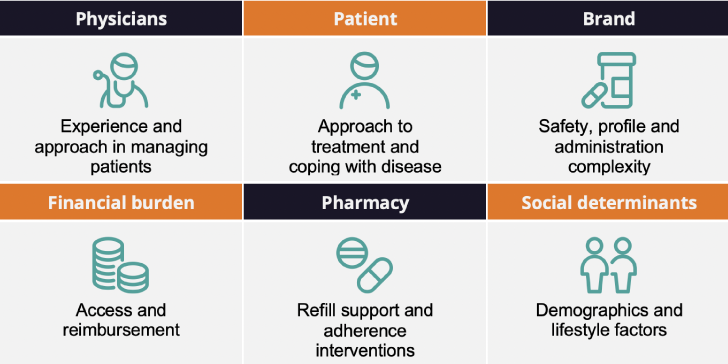
Medication adherence is influenced by a variety of interactions between patients and the healthcare system, and mining which experiences along the patient’s journey are most often responsible for therapy discontinuation is a difficult exercise. Based on our experience in both primary and specialty markets, we recommend a holistic, six-dimensional framework that evaluates a wide spectrum of potential influences and that identifies key factors in driving low patient retention in a given therapy area or brand, as follows:
FIGURE 1: Key factors driving patient retention
Prioritizing barriers is important before defining business strategy
The above framework outlines a comprehensive tool to mine specific barriers to patient retention on a particular therapy. Quantifying each factor’s impact on adherence is crucial for brand teams that might then prioritize and optimize their investments to ultimately deliver maximum value to the patient. We recommend that organizations further evaluate and prioritize these barriers based on:
- Their impact on an individual patient’s adherence
- The total number of patients they influence away from adherence
- The extent to which they can be addressed by manufacturers
We discuss each of the framework’s six dimensions in turn.
- PhysiciansTherapy management can be especially difficult for physicians working with medications that are either new to the market or that have poor safety profiles requiring active dose management and treatment holidays. Likewise, a physician’s limited experience in a given therapy area or class influences their ability to navigate intricate treatment guidelines, particularly when treating patients with high disease severity, risk stratifications, comorbidities or compromised immune systems. We also observe treatment drop-offs when practices are not able to refer patients to specialized facilities that can better support patients in maintaining their medication course, or when physicians lack easy access to resources, such as case-management toolkits and Key Opinion Leader (KOL) guidance, which can help in effectively managing complex patients.
- PatientAnalyses show that repeated follow-ups, ER visits, complex testing requirements and evaluations put a strain on patients, limiting their ability to successfully adhere to their medication regimens. Complex or chronic conditions further enhance the risk of patient disengagement. Polypharmacy (multidrug regimens) or general concomitant treatment, which requires keeping track of multiple medications simultaneously, can likewise lead to patient forgetfulness, confusion and ultimately disengagement, resulting in an overall deterioration in patient outcomes.
- BrandComplexities in drug administration and medication experience can play a substantial role in disease management and patient adherence to medication regimens. These may include ease of intake (for example, oral as compared to intravenous delivery, prefilled as compared to non-prefilled injections and the potential need for a specialist to administer doses), additional instructions (crushing tablets, opening capsules, increasing or decreasing doses or meal-dependent timing) and the frequency of administration. We have also observed that a medication’s tolerability profile can be a crucial factor in patient retention. While less severe side effects may result in patient complaints and the need for support, unexpected or severe side effects can nudge both patient and physician to opt for treatment holidays or to substitute the therapy altogether in favor of a more tolerable drug.
- Financial burdenThe economic burden imposed by medicating can exert a major impact on the patient experience and can lead to missed doses or complete medication drop-off. This impact is more pronounced in patients from lower income groups, with limited payer coverage or undergoing expensive therapies with substantial out-of-pocket costs as in the case of many cancer or rare-disease therapies. Patients performing cost-benefit analyses to weigh their need for medication against the medication’s financial cost may decide against continuing treatment.
- PharmacySpecialty pharmacies have become an integral part of the patient’s treatment journey. They play a significant role in providing benefits investigation and prior authorization support, disease and product education and patient interventions including refill reminders and adverse event (AE) management guidance. Analyses suggest that variability in the quality and effectiveness of such services across pharmacies can lead to delays, rejections or repeated patient triaging between pharmacies, all of which may influence a patient’s decision to discontinue medication. Suboptimal pharmacy services, including in patient education and intervention, further risk leaving unresolved patients’ queries on managing their treatments.
- Social drivers of health (SDOH)Social determinants play a nuanced role in informing the quality of immediate care and awareness available to patients. Specific populations including racial minorities, limited-income households, low education groups and the elderly can struggle with navigating through treatment complexities and actively managing their disease or condition through proper and continued medication.
Using the multidimensional framework to define business strategy
Improving patient retention is a multidisciplinary challenge that requires a blend of business strategies to overcome. Our experience suggests two guiding principles for manufacturers to develop the right business strategy: a targeted approach at the local level, and a coherent effort supported by analytics capability.
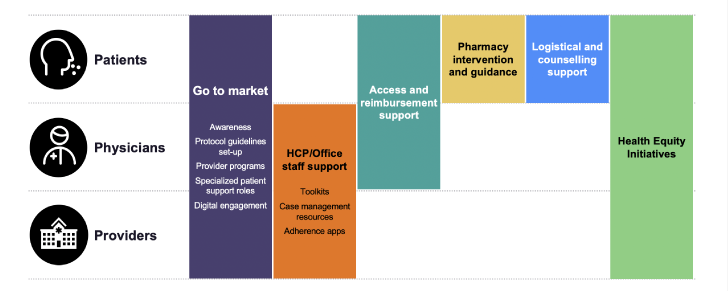
1. A targeted ‘local’ approach: The range of local business strategies that can be designed to navigate barriers to patient retention is exemplified in the following diagram. There is a high degree of local variation in patient demographics, awareness, treatment practices, healthcare access, social strata and other identifiers. A successful business strategy needs to design adherence programs based on the needs of patients and providers in a particular geography. The local deployment should target three key stakeholders:
- Support patients beyond co-pay and reimbursement. Deploying digital apps and specialty pharmacy interventions, suggesting appropriate pharmacies based on patients’ plans and partnering with advocacy groups and communities to provide resources and to drive awareness are only a few examples of how manufacturers might help patients to manage their medication more effectively.
- Support physicians and office staff based on their specific needs. For example, differential deployment of medical science liaisons (MSLs) in practices requiring help with treatment management protocols could facilitate scientific information sharing on specific questions. Physicians’ offices in rural areas can be supported with case management toolkits and the latest KOL-endorsed clinical guidance around AE management.
- Support providers in driving effective patient management practices in their networks. Such initiatives could cut across beyond-the-pill programs, protocol education, health inequity campaigns and sharing real-world evidence (RWE) studies, among other solutions.
FIGURE 2: Business strategies to target the 3 key stakeholders
2. Coherent internal strategy: Manufacturers should work to unlock quick wins with the help of existing solutions and build newer solutions both internally and with external stakeholders including hospital networks, pharmacies and patient groups. It remains essential, however, to bring a concerted effort to ensure that internal functions—including medical, marketing, sales and analytics—design their programs with a common understanding of patient and provider issues. A strong analytical arm supported by real-world data, artificial intelligence and machine learning can bring significant value in mining insights and can align internal functions around a common understanding of adherence issues. Effective leadership and a strong organizational culture play a crucial role in bringing the necessary analytics innovations to the forefront and in clearing barriers for taking action based on insights.
Related insights
zs:topic/customer-experience,zs:topic/data-digital-and-technology,zs:topic/research-and-development