Real-world data and evidence industry outlook report
The use of real-world data (RWD) and real-world evidence (RWE) is exploding across the pharmaceutical industry, adding value at every stage of the product life cycle. Driving this trend is a growing acceptance of RWE among healthcare stakeholders—policymakers, providers, payers and patients—and the accelerating availability of RWD, technology and advanced analytics in the industry. With so much innovation, it can be hard for pharma companies to determine how to enable a more collaborative, effective use of RWD—and where to start.
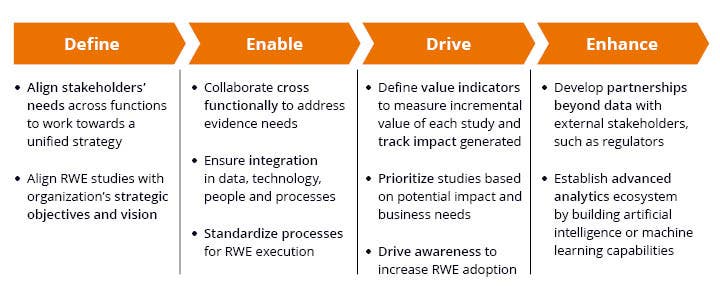
As pharma companies ramp up their investments in RWD and RWE, they must understand why using it becomes vital to remain competitive and drive differentiation in a value-based, patient-centric healthcare system. Beyond that, they must also continue to find the right opportunities to invest in their RWD and RWE capabilities altogether. Pharma companies can follow a systematic, four-step approach to help scale the value of RWD and RWE investments over time (Figure 1).
Figure 1: Recommended investment model for RWD and RWE
Evolution of the RWD and RWE landscape
The healthcare ecosystem is increasingly leveraging RWD and RWE to better understand patients’ experiences and health outcomes, as well as support product access and approvals. Different stakeholders use and benefit from RWD and RWE in a variety of ways to achieve their objectives:
- Policymakers: To better comprehend patients’ unmet needs (e.g., for rare diseases and sub-populations of more common diseases), as well as ensure safety and effectiveness of new or repurposed treatments
- Payers: To assess a treatment’s cost effectiveness by evaluating its impact on how patients use healthcare resources
- Providers: To improve quality of care and treatment at the patient level while considering each patient’s demographic, medical history, omics profile, and social and behavioral determinants of health
- Patients: To understand the probability of improvement in symptoms and underlying diseases, as well as long-term safety and costs
Historically, RWE has been limited to safety and post-marketing use cases as required by regulatory agencies. However, in the last few years, pharma has increasingly used RWD and RWE across a variety of areas, including clinical development, medical engagement, value and access, and lifecycle management. This surge has led to an emergence of new and innovative applications of RWD and RWE, including but not limited to biomarker identification for early diagnosis, synthetic control arms for faster clinical trials approval, value-based contracting for favorable reimbursements, and patient prediction for earlier identification and treatment.
Although pharma still has a way to go to truly maximize the opportunity of RWD and RWE applications, the industry has nonetheless increased its RWD and RWE capabilities in multiple areas (Figure 2).
Figure 2: RWD and RWE adoption since 2018
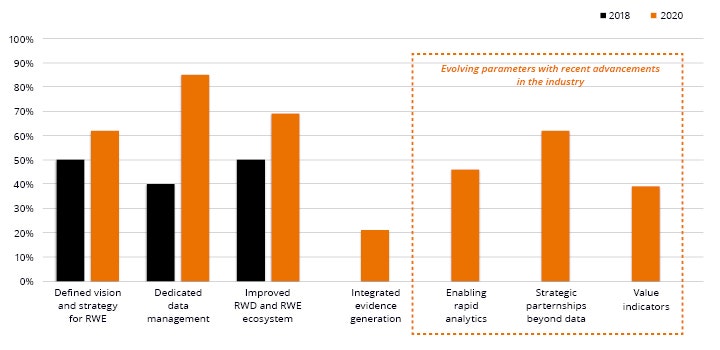
- Defined vision and strategy for RWD and RWE: Most pharma companies have a clear vision and a strategy to achieve that vision, as organizations become more cognizant that investments in data, technology, and people should be made for a specific purpose. Having a clear vision has helped companies define and achieve a consistent product value story across functions and streamline investments and study planning. According to ZS’s recent benchmarking study, nearly two-thirds (62%) of surveyed companies have an effective cross-functional RWE vision—a 12% increase from 2018—marking a significant shift from when RWE investments were made with unclear objectives or on an ad-hoc basis. Still, there’s room to grow, and organizations need to continually break silos and define a comprehensive RWE strategy that proactively plans evidence needs and RWD budgets to help address stakeholder requests and competitive challenges.
- Dedicated data management: Companies are constantly working to maximize and manage their data, from enabling central visibility, data exploration and avoiding redundant data purchases to enhancing quality management and standardization of data. In fact, 85% of companies surveyed in ZS’s benchmarking study said they have dedicated measures to manage their data, while only about 40% said the same in 2018.
- Increasing focus on data partnerships: While pharma companies are heavily investing in RWD—from direct purchasing and partnering with vendors and hospitals to collecting data in difficult markets—few are collaborating and using acquisitions to collect data for new therapeutic areas or use cases. Such curated data sources support innovative evidence needs, especially in challenging data landscapes and rare diseases. Taking a proactive approach to fulfilling data requirements helps overcome challenges associated with data availability, privacy and compliance regulations.
- Ecosystems enabling consistent and scalable use of RWD: More than 60% of organizations surveyed in ZS’s benchmarking study said they’ve significantly enhanced their analytical skills and invested in tools and platforms to support their RWD and RWE needs. As the volume of data sets and novel data sources increases, so does the need for flexible, scalable data storage and computing capabilities. Aligning the right people skills with making this data more accessible will enable quicker decision making, rapid evidence generation, and stronger analytics.
How to maximize RWD and RWE potential
Although the pharma industry has realized the significant potential of RWD and RWE across various core investment areas, there’s still room to maximize its value and create a competitive advantage.
- Enable integrated evidence generation: Breaking down silos and fostering collaboration across functional areas has long been a challenge for pharma companies. Customer-facing functions are solely focused on identifying stakeholders’ RWD and RWE needs, while individual internal functions are assigned to support these needs, and at times keeping needs of only a subset of stakeholders in consideration. Nonetheless, some industry leaders are breaking these silos and enabling more cross-functional collaboration when it comes to RWD decisions, RWE outcomes alignment and communicating to the outside world as “one organization”. Organizations that have focused their efforts on integrated evidence generation have an edge over their competitors.
- Develop rapid analytics: The development of RWD-enabled analytics is often slowed due to the varied data sources and applications of RWD and RWE analytics and research within pharma companies. Different functions, as well as individuals within functions, run their own analyses with often limited collaboration, varied analytical capabilities, and little cross-functional governance. In fact, 54% of companies surveyed in ZS’s recent benchmarking study said they’re struggling to expand RWE-use cases due to a lack of standardization and prioritization. To help fix this, pharma companies must streamline their end-to-end RWE analytical processes across the organization; establishing collaborative platforms with automation and rapid analytics capabilities. This will help streamline centralized studies, more efficiently meeting stakeholders’ needs.
- Increase awareness to drive RWE adoption: ZS’s study found an inconsistent understanding of the potential application and value that RWE plays across internal functions. Educating functional teams on the impact and value of RWE insights must be done on a persistent basis; leadership should use examples of past RWE implementation within their organization as well as the broader pharma industry to build trust in data and outputs within their teams. In addition, coaching teams to plan, execute and disseminate evidence can help in building a cross-functional culture and credibility among internal and external stakeholders.
- Create strategic partnerships beyond data: Despite increased interest within pharma to partner with key stakeholders such as regulators, payers and providers for data access, limited collaboration efforts have been made elsewhere. Pharma companies must proactively engage with these groups to better understand evidence requirements and align on how to design and execute RWE studies that meet these stakeholders’ standards. These partnerships will go a long way in ensuring RWE studies are accepted, thereby informing treatment guidelines and access decisions.
- Define value indicators to drive business objectives through RWE: Many pharma companies have made significant investments in RWD and RWE due to the sheer volume of excitement it has gained in the industry over the past few years. However, these investments have often gone unchecked, leading to an ad-hoc nature behind many of the RWD and RWE investments to date. Moving forward, pharma companies should assign measurable value to their RWD and RWE efforts, which can help secure budgets and prioritize different opportunities. Moreover, value indicators—such as reduced costs and timelines, increased probability of approval, favorable access, and enhanced scientific leadership—are needed to define SMART (specific, measurable, attainable, relevant and timely) KPIs, as well as measure a study’s impact and return on investment. Value indicators also allow businesses to objectively measure impact. Lastly, advanced metrics that track requests, ongoing research, business value of RWE studies, and volume of support needed for execution must be incorporated by each functional team.
The path forward
In today’s digital world where data has become an asset for organizations of all sorts, understanding how it can be used to generate value through evidence can take pharma companies to the next level. But the work doesn’t end there. Pharma companies must consider how they can be more innovative in the use of RWD and RWE to achieve their internal missions as well as drive value for patients. This is where the difference—and impact—is truly made.
The insights in this whitepaper are from ZS’s 2020-21 RWE benchmarking study, comprising of views from more than 25 RWD AND RWE leaders and experts representing 14 large and mid-size pharma organizations, as well as ZS’s own RWE expertise center.
Harika Kandukuri and Aashray Bhatia contributed to this article.